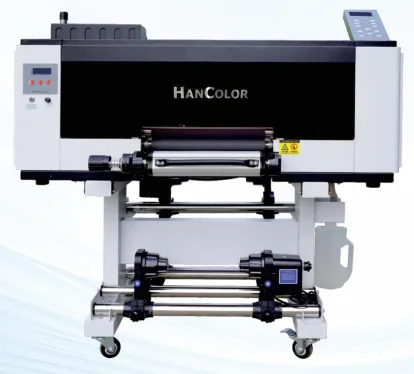
HANCOLOR
UV DTF printers
The short answer
UV DTF prints an adhesive-backed transfer that is applied with pressure instead of heat, which is what makes it work on finished and heat-sensitive objects. The range covers 300 mm and 600 mm widths with three to four heads. The variables that decide success are the film pair, the ink and the surface preparation — test the finished transfer on your actual product before production.
A UV DTF configuration for printing transfers for suitable bottles, gifts and other objects. Confirm the compatible film, ink and lamination setup. Test the finished transfer on your actual material before production.
4 models
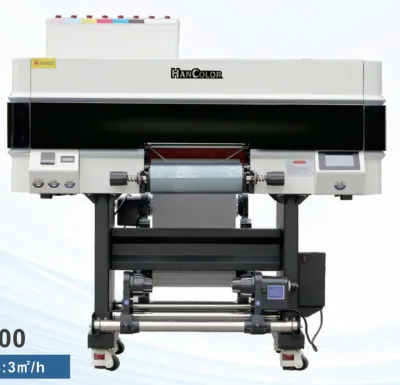
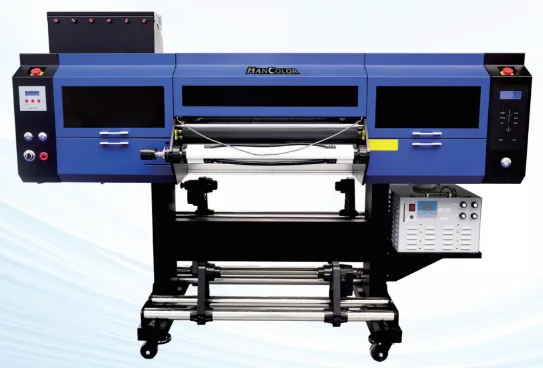
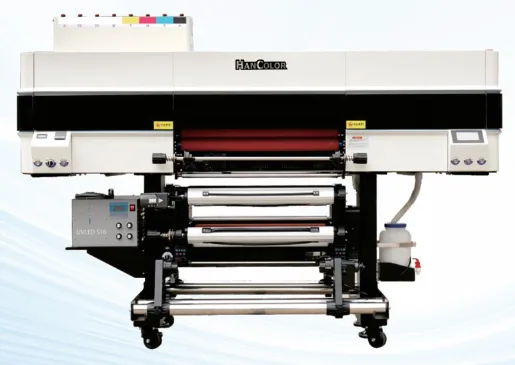
No matching products. Try another term or contact us.
What to confirm before ordering
Discuss your material, required output, electrical supply and accessory package with our sales team.
Tell us what you print
Share your material, maximum width, expected output and destination country.
Confirm the configuration
Discuss printheads, ink, software, accessories and a sample using your artwork.
Agree the order details
Confirm the equipment list, payment terms, shipping and support before ordering.
Compare every UV DTF printers model
Every configuration in this range, side by side. Speeds are the 4-pass catalog figure where the catalog lists one, otherwise the fastest pass the catalog gives.
| Model | Working width | Printheads | Catalog speed |
|---|---|---|---|
| 8030-3(UV) | ≤ 300 mm | 3 × Epson XP600 / I1600 | — |
| 30cm UV DTF | 300 mm | 3 × Epson XP600 (F1080) | 4 m²/h · 6-pass |
| 60cm UV DTF | 600 mm | 3 × Epson I3200-U1 | 7 m²/h · 6-pass |
| 8060-3(UV) | < 600 mm | 4 × Epson I3200-U1 | 6 m²/h · 6-pass |
All figures transcribed from the 2026 Hancolor catalog. Confirmed configuration is defined by the agreed quotation.
UV DTF printers
Product questions
What is UV DTF printing used for?
Producing adhesive transfers — print onto a special film, laminate it, then apply the transfer by hand to bottles, cups, gifts, packaging and other suitable objects. It is popular because you can decorate pre-made items without printing on the object directly.
How is UV DTF different from garment DTF?
Garment DTF prints onto film and is then heat-pressed onto fabric, using hot-melt powder as the adhesive. UV DTF produces a self-adhesive transfer that is applied cold to a rigid or coated surface. The inks, films and finishing steps are different and are not interchangeable.
What should I confirm before ordering the consumables?
Confirm that the film, ink and lamination are a matched set for your printer, and that the transfer holds on your actual object. Test on the real surface — curved, glossy and low-surface-energy plastics behave very differently from a flat sample.
Contact
Let’s discuss your next printer.
Tell us what you want to produce. We will help you identify a suitable configuration.
WhatsApp+86 187 3600 3282
Company addressRoom 3606, Block A, Shenglong Jinzhonghuan, Haifeng West Road Street, Zhengzhou, Henan, China
Factory addressZhongyuan Printing Industrial Park, Yuanyang County, Henan, China