The demonstration targets the two bottlenecks that manual DTF workflows are best known for: powder waste and manual handoffs between printing, powdering and curing. The announcement describes a live demonstration; it does not publish throughput figures or the price of the automation lines.
For print buyers
Automation earns its cost when daily volume already keeps a manual line busy. If you are specifying a DTF setup, ask how powder is applied and cured in the exact configuration you are quoted, and whether the shaker and curing unit are included or priced separately.
What the demonstration actually shows
DuPont Artistri is running two automation lines built by Brown Manufacturing Group continuously at its PRINTING United Expo booth, taking the DTF process from film printing through to the finished transfer without manual handoffs between stages.
The two problems the demonstration is aimed at are the two every DTF operator recognises: powder waste, and the labour of moving film between printing, powdering and curing. The announcement describes a live demonstration; it does not publish throughput figures or the cost of the automation lines.
Why powder handling is the manual bottleneck
A DTF workflow has four steps: print the design onto film in mirror image, apply hot-melt powder to the wet ink, cure the powder, then press the transfer onto the garment. Steps one and four are already machine operations on any current DTF printer.
Steps two and three are where manual DTF differs most from one workshop to the next. Powder applied by hand is uneven and largely wasted, and moving film by hand between the printer, the shaker and the curing unit sets the pace of the whole line.
That is why the commercial argument for automation is a labour and materials argument rather than a print-quality one. The printhead and the ink still decide what the print looks like.
When automation is worth considering
Automation pays for itself against a manual line when the daily volume already keeps that manual line busy. Below that point the constraint is demand, not handling speed.
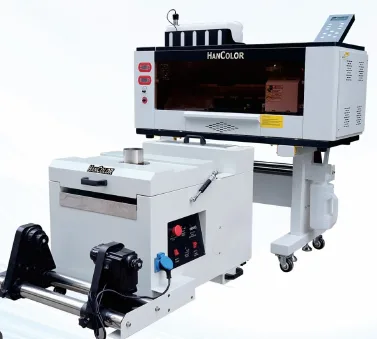
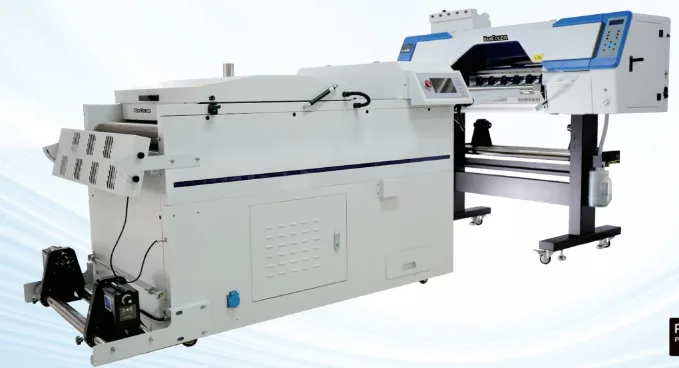
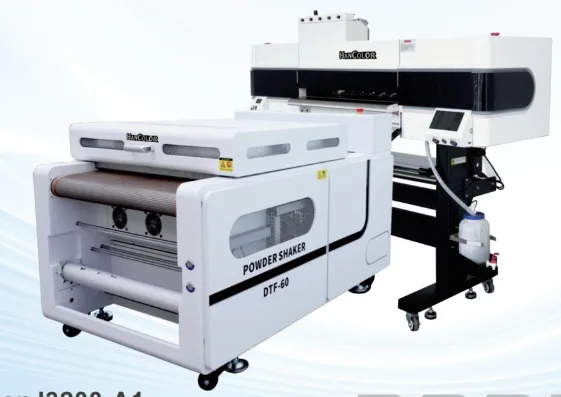
A useful first question is not whether automation exists, but how powder is applied and cured in the exact configuration you are being quoted. In our DTF range the powder unit changes with print width: DF-300S on the 300 mm models, the HD-700N series on the 600 mm models, and the DF-900 and DF-1200L series on the wider machines.
Ask for that machine, the shaker that matches it, and whether the curing unit sits inside the quoted figure or beside it. Those three lines answer most of the automation question for a given volume.
Source: DuPont Artistri / TEXINTEL ·